


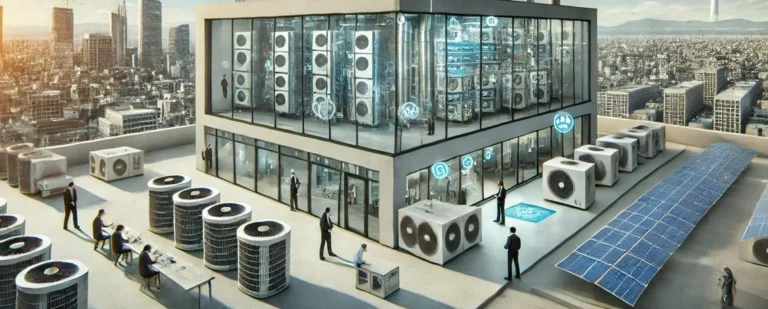
A commercial house is not merely a building; it needs smart systems to respond to the occupants’ needs. Thus, smart HVAC installation is essential to transform the building. Modern technologies have redefined the way to heat and cool the space.
The increasing energy demands and sustainability trends have made smart HVACs popular. They are intelligent climate control systems with automation and data analytics. You can invest in commercial electrical services to build a smart infrastructure with the latest HVAC system.
Technologies used for smart commercial HVACs
Traditional HVAC systems are designed to work only on manual inputs and fixed schedules. But, smart models dynamically adjust settings depending on real-time conditions like-
- The time of the day
- Weather patterns
- Occupancy level
However, which technologies have been integrated with your new commercial HVACs?
ML and AI
Commercial property owners have invested in AI-powered HVAC systems that-
- Learn from the past data.
- Predict your energy needs.
- Automate adjustments to lower energy waste
The predictive capability prevents the risk of overheating and overcooling. The built-in AI and ML technologies analyse performance patterns of your HVAC. They also help with proactive scheduling of HVAC maintenance to prevent potential failures. In the long run, you will benefit from maximum system uptime.
The ML technology also learns from your preferences and adjusts temperatures accordingly.
IoT in HVAC
IoT used for HVAC has created an efficient system.
Modern IoT-driven devices allow you to remotely control temperature through apps or voice commands. Smart HVACs with IoT rely on different core components.
- Hubs- Central units for data analysis, allowing real-time decision-making
- Sensors- Smart thermostats to collect data on temperature and humidity
- User interfaces- Smartphones and applications allow effortless interactions with the system.
- Controllers- Equipment for controlling HVAC operations
So, the interconnected HVAC components work together to provide a seamless experience. However, you need to call commercial HVAC contractors for proper installation.
Automated and remote controls–
Commercial facility managers find it easy to manage their HVAC systems remotely. It takes a few clicks on a mobile app to control the heating and cooling units.
Automated scheduling depends on the time and occupancy patterns. It means there is no need for unnecessary heating or cooling when the building is not occupied.
Wi-Fi connectivity
Wireless technology innovations have simplified the way to control your room temperature and airflow. Use Wi-Fi-connected software to control the climatic conditions of your facility.
Besides, Wi-Fi connection allows your HVAC maintenance experts to monitor the system anywhere. They collect data and generate reports to detect-
- System’s performance status
- Past performance
- Usage trends
When your HVAC systems need repairs, contractors can easily diagnose the problem.
The use of smart HVAC controls in various industries
Businesses of different niches have invested in smart commercial HVACs for their buildings.
- Office units- Adjust various zones depending on schedules and occupancy.
- Retail outlets- Maintain comfort for employees and customers while reducing energy consumption during off-hours.
- Industrial buildings- Optimal cooling and ventilation machinery- You will also benefit from a highly efficient workforce.
- Healthcare centres- Ensure precise humidity and temperature control for your patient safety.
Thus, you will get a custom cooling and heating solution based on your building type.
How do smart HVAC controls benefit your commercial building?
The integration of smart technologies into HVAC systems provides several benefits.
Save costs with better energy efficiency
Automated temperature adjustment features have made your smart HVACs more energy-efficient. The system works only when you need it. Besides, identify high-energy usage patterns by implementing targeted efficiency measures.
You will find low energy bills every month.
Feel more comfortable
Comfort is the most significant factor in most commercial facilities, as it influences-
- Your wellbeing
- Customer satisfaction
- Your employees’ productivity
Smart HVACs maintain indoor temperatures with continuous adjustments based on external weather. However, you may also customise the environment on your own for a personalised experience.
Improve air quality
Indoor air quality in your commercial facility should be high to prevent health issues. Smart HVAC systems can check air quality parameters, including-
- Pollutants
- Humidity
- CO₂ levels
A decline in air quality prompts the system to increase ventilation automatically. Thus, your employees will experience a healthier indoor environment in an office.
Challenges that you must know
Although smart HVAC provides substantial benefits, they pose a few challenges-
- The upfront cost of buying these smart systems is extremely high.
- Data security issues due to the connected systems
- Complexity in integrating various systems
- Need specialised knowledge for proper installation
Conclusion
Smart HVAC technology has created a dynamic environment in the commercial building. It leverages IoT and AI to deliver unparalleled comfort. Investment in smart systems has become a necessity for companies that want to stay competitive. In the future, commercial HVACs will be more autonomous with the capability of making complex decisions.
